The Public Interest Technology Graduate Certificate's foundational curriculum helped structure my graduate research in surveillance technology and AI governance. The coursework and bibliography introduced me to cutting-edge governance concepts and versatile, global applications of PIT values. Guest speakers from a wide array of technical, policy, and academic professions joined class meetings to share their experiences and offer guidance to students interested in pursuing similar career paths. Through literature, lectures, and networking opportunities, the PIT Certificate has ushered me into an eclectic professional space I am proud to join. ~Nurah Jaradat
My most valuable takeaway from the PIT Graduate Certificate program was an understandable lens to view the massive changes going on in the technology world. Before taking these courses, I had an awareness of the prevalence of AI and other advanced technology systems. But after, I had an understanding of the consequences and effects of these technologies and a framework to actually address the problems and offer effective solutions that act in the public interest, not just in the private interest. ~Gregory Boisvert
The PIT Grad Certificate's greatest value for me was situating AI — my chosen focus — within the broader landscape of technology, ethics, law, and social impact, from data protection and platform governance to digital sovereignty and geopolitics. For someone in an unplanned career transition, carrying deep experience in democratic governance and human rights into a new field, the shared framework of public interest technology values provided exactly the bridge I needed: a vocabulary I already understood, reframed for a different set of challenges. Design decisions are governance decisions, and the communities with the least influence over those choices are often the ones with the most at stake. ~Tara Thwing
Undergraduate Programs
Completing the PIT Undergraduate Certificate helped me delve deeper into how society operates in the digital age and how impactful good (or bad) technological advancements can be. As someone who has always been a part of the humanities world, I really appreciated how completing this certificate gave me the confidence and skills to operate in the technological world. ~Brynn Geary, Communication and Sociology
There's no way to remove ourselves from technology or remove technology from our world, so the most valuable thing that we can do is understand how to use it ethically. This is something I believed before coming to UMass, so in a way I was thinking about PIT before I even knew the certificate existed. The PIT program gave me the awareness not just to see the ways in which technology is affecting humanity, but gave me the tools to actually begin to make change for the public interest. ~Guy Zwiebel, Philosophy
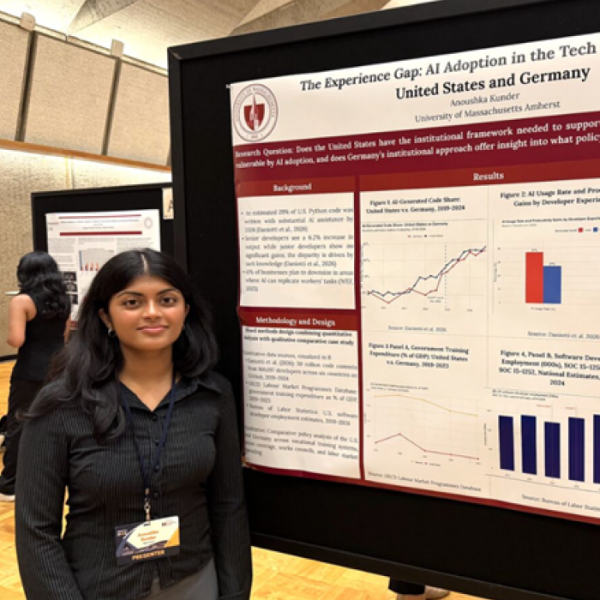
As a public policy major interested in the intersection between technology and policy, PIT offered me an opportunity to explore questions such as who gets to shape the technology systems that increasingly govern our lives. These questions ended up shaping my honors thesis on AI adoption and junior software developer displacement. More broadly, the certificate helped me understand how issues like algorithmic harm and corporate accountability can be translated into advocacy and policy reform. I’m excited to carry these tools into my future career! Anoushka Kunder, Public Policy
Through the AI4CW program and CICS 590P, I learned that successful technology starts with people. The program taught me to approach problems inclusively and iteratively, design alongside real users, and think critically about the intersection of policy and technology. I carry those lessons into my own product today by beginning with community needs and human-centered design rather than the technology itself. That mindset has helped me build features that solve real user problems instead of simply showcasing technical capabilities. More than anything, PIT taught me how to create technology that is ethical, empathetic, and genuinely useful. ~Dev Mehta, Computer Science
PIT encouraged me to hone a people and community-centric outlook towards technology. Each class that I took as part of the certificate has inspired me to be on the conscientious side of technological advancement. In fact, some of the most memorable classes that I have been enrolled in during my time at UMass, have been in pursuit of the certificate. Through engaging with admirable faculty and peers, I have learnt a great deal about PIT's impact across fields such as economics, sociology, information science, data science, and others. I feel incredibly grateful to have completed this certificate and I look forward to exploring PIT post graduation. ~ Anisshka Annand Khadtale, Managerial Economics
The PIT Certificate opened doors to courses across disciplines and colleges that I wouldn’t have accessed otherwise. As someone with wide-ranging interests, I found this incredibly enriching. I took a nonprofit management course where I explored the inner workings of mission-driven organizations and learned directly from experienced professionals in the field. I also enrolled in English department classes that taught me how to build an online portfolio using HTML and CSS. Most importantly, I developed a meaningful understanding of how to apply technology ethically and for social good, while also helping foster a community committed to that mission. ~ Aastha Agrawal, Computer Science
The PIT program allowed me to meet people who have the same concerns as I do. Being a computer science major, you don’t get to meet many people who care about the harm that technology is causing and will cause in the future without proper legislation. This program has given me the chance to learn from people that put humanity first, and the confidence to advocate for and develop ethical technology. ~ Angelika Ladia, Computer Science